Zhaoqing Three-day Tour [Essential Itinerary]
2 cities |
9 attraction(s) |
total distance 123
km
 TIPS
TIPS
Day1
Day2
Day3
Day1: Zhaoqing
3 attraction(s) ·
5 km
1

This tourist scenic area consists of five lakes, six hills, seven rocks, and eight caves. There are mountains in the lakes, caves in the mountains, and rivers in the caves, known as the "fairyland on earth". Visitors can climb Tianzhu Rock, visit Xianu Lake, explore the caves of Shishi Cave, and take a boat tour of the Red-crowned Crane Eco Park. In the Qixingyan cliff stone carving group, Tang Dynasty Li Beihai's regular script "Duanzhou Shishi Ji" is a rare treasure, and it is one of the places in Guangdong Province with the most and most concentrated rock carvings. Every weekend, tourists can go to the Helet Pavilion in the Shuiyue Palace to experience Cantonese opera performances and experience the beauty of culture.
4
km
2

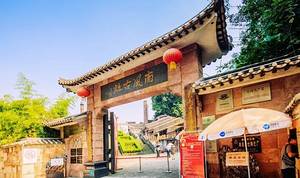
Yuejiang Tower is a typical Guangdong Siheyuan-style architectural complex, and the evening view from the Jiang Tower has always been praised as one of the eight scenic spots of Zhaoqing. Inside the courtyard, there are three ancient Milan trees over 300 years old, which legend says were planted by a scholar. The Milan ancient trees bloom twice a year, with a fragrant flowering period that brings joy to people's hearts. The two characters "福寿" (Fu Shou) inscribed on the east side of the Songtai Academy are uniquely shaped and are not commonly seen in the country, written by Chen Tuan at the end of the Tang dynasty and the beginning of the Song dynasty. The character "寿" (Shou) is in seal script, while the character "福" (Fu) is in running script. Seal script appeared earlier than running script, symbolizing longevity in old age, fortune in youth, with blessings as vast as the East Sea and longevity as high as the South Mountain. Later, people liked to hang Chen Tuan's character "寿" at home to pray for long-lasting blessings and longevity, wishing for a long life of a hundred years.
2
km
3
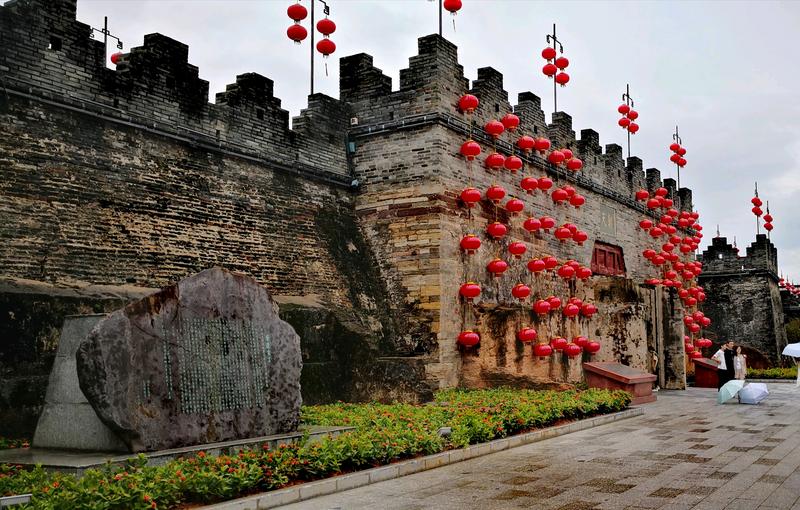
The ancient city wall of Zhaoqing with a perimeter of 2800 meters has undergone more than 20 repairs, but the position of the wall and gates has never changed. It was first built in the Song Dynasty and is still well-preserved, which is rare in the country. Piyun Tower is located in the western section of the ancient city wall, built in the third year of the Northern Song Dynasty's Zhenghe period and is still intact. As the tower is located at the highest point of the city wall and is often surrounded by clouds, it is named Piyun Tower, and "Piyun Crane Tears" is known as one of the Eight Ancient Sights of Duanzhou.
Day2: Zhaoqing
3 attraction(s) ·
49 km


3

The Baogong Temple is located on the Xiaozhou of Xianghuadun in Baohu Park, at the east section of Huan Cheng Nan Lu in Hefei. It is one of the core ancient buildings in the park. The temple was built during the Guangxu period of the Qing Dynasty and still retains its majesty despite the passing of time. The temple was built in honor of Bao Zheng and consists of a closed courtyard with white walls and blue tiles. The main building is the Baogong Hall, which houses a tall statue of Bao Zheng and a carved stone statue of Baogong. It is mighty and indomitable. To the west of the hall is a curved corridor, and to the east is a hexagonal Longjing Pavilion called "Lianquan", which is said to have exceptionally clear water and was once called "Lianquan" in history. The temple is surrounded by water and displays many genealogy, relics, calligraphy, and historical documents related to the Bao family. Adjacent to the temple is the Baogong Cemetery. Legend has it that Bao Zheng was concerned about the well-being of the people and even cared for plants. It is said that the red lotus roots he cultivated did not produce silk. This story has been passed down to this day.
Day3: Zhaoqing > Foshan
3 attraction(s) ·
30 km