Madrid in 3 Days: History, Art and Neighborhood Life
1 cities |
24 attraction(s) |
total distance 18
km
 TIPS
TIPS
Day1
Day2
Day3
Day1: Madrid
8 attraction(s) ·
3 km
1
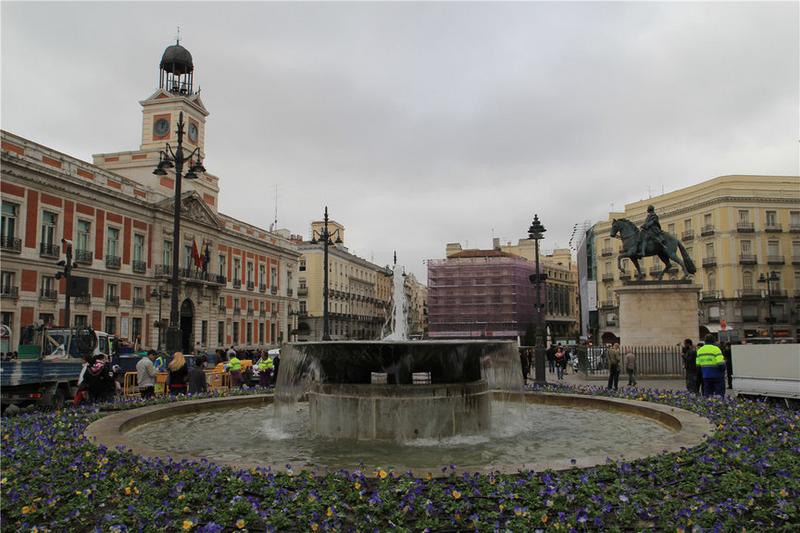
The Puerta del Sol Square originated from the 15th-century Madrid city gate and was named for facing the direction of the rising sun. The earliest building on the square was the old post office building in the 18th century, which is now the government building of the Madrid Autonomous Community. During Franco's period, the government building was the national security headquarters, and the lower half-elliptical windows of the building once held prisoners who opposed Franco's rule. In front of the building, near the driving route, is the "Kilometer Zero" sign and the center of the Spanish national road network.
Two important sights on the square are the statue of Carlos III and the "Bear and Strawberry Tree." Carlos III was the king of Spain during the Bourbon dynasty and was born in Madrid. He devoted himself to building public facilities in Madrid during his reign and is still known as the "greatest mayor of Madrid." The "Bear and Strawberry Tree" is the emblem of Madrid, which first appeared in the 13th century. The bear was to commemorate King Alfonso XI of Castile, who hunted a bear on the surrounding mountain of Madrid. The strawberry tree originates from the wild strawberry tree growing around the square.
1
km
2
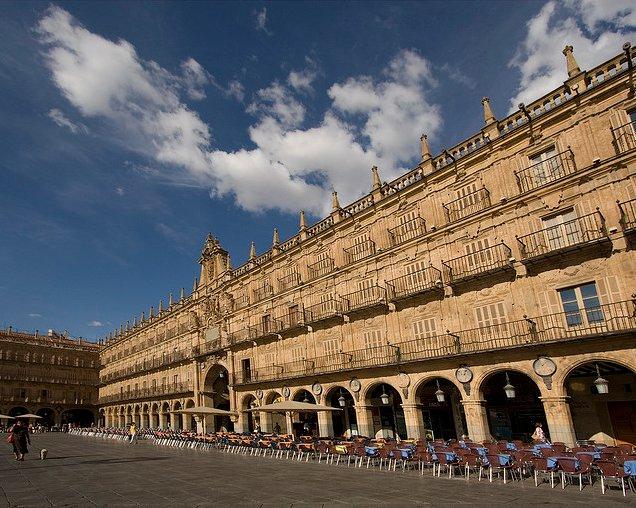
The main square, also known as Plaza Mayor or Plaza de Mayor, located in the center of Madrid, is a historic square built during the Habsburg dynasty, adjacent to Puerta del Sol. The square is rectangular, 129 meters long and 94 meters wide, surrounded by three-story residential buildings with 237 balconies facing the square. There are nine entrances to the square. The main building of the square is Casa de la Panadería, serving both as a municipal building and a cultural center. Its exterior walls are covered with murals.
1
km
3

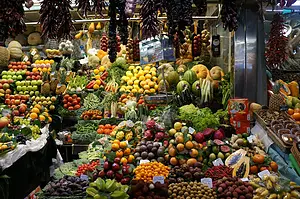
Circa-1916 covered market offering local food, delicacies & events in an elegant ambiance.
1
km
4

The Museo de la Catedral de la Almudena is a museum that showcases the history of the Church in Madrid. The Almudena Cathedral is the Catholic cathedral located on the western side of the city center and is the patron saint of Madrid. The construction of the cathedral was originally planned in the 16th century, but it didn't begin until 1879 and was interrupted by the Spanish Civil War. The cathedral was finally completed and opened in 1993 under the consecration of Pope John Paul II. The exterior of the cathedral is in Baroque style, while the opposite Royal Palace is a white and grey structure. Inside the cathedral, there is an original statue of the Almudena Virgin, located in a chapel on the western side.
1
km
5
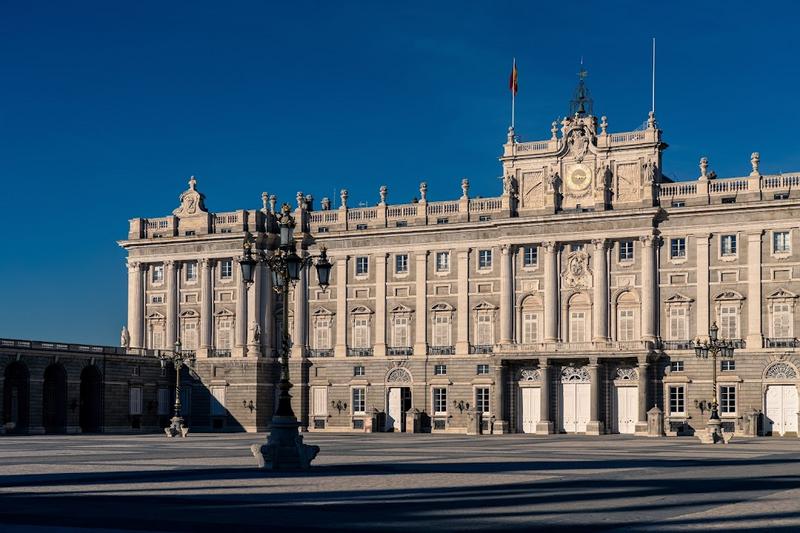
18th-century, ridge-top palace for state occasions, plus tours with rooms full of art and antiques.
1
km
6

Located in the 1930s, the Sabatini Gardens, formerly known as the Royal Stables, have trees trimmed into unique shapes, adding more charm. In the summer evenings, there are various charming open-air performances including classical music, jazz, and stage plays.
1
km
7
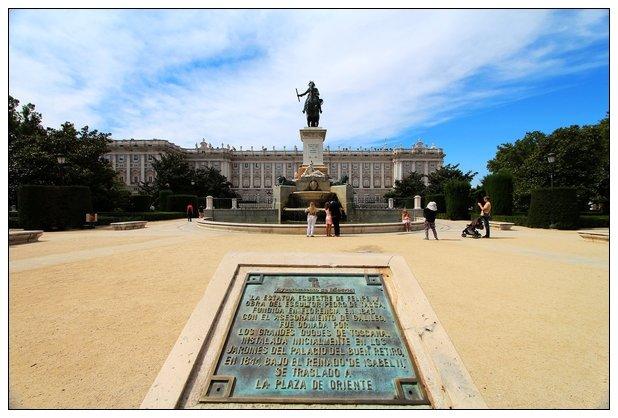
Oriental Square, located in the center of Madrid, is a charming garden-style square built during the Joseph Bonaparte period in the 19th century. The west side of the square is the Royal Palace of Madrid, while the east side is the Royal Theatre. The magnificence of these two grand buildings adds to the square's imposing presence. On the side of the Royal Theatre, a series of small bars are arranged in a semi-circle, providing tourists with an excellent place to rest and enjoy the surrounding scenery. Inside the square, there are fountains and a statue of King Philip IV riding a horse, designed by Velázquez, for tourists to admire. As the foreground of the Spanish Royal Palace, Oriental Square and the palace form a spectacular scenic line, attracting the attention and snapshots of many visitors.
1
km
8
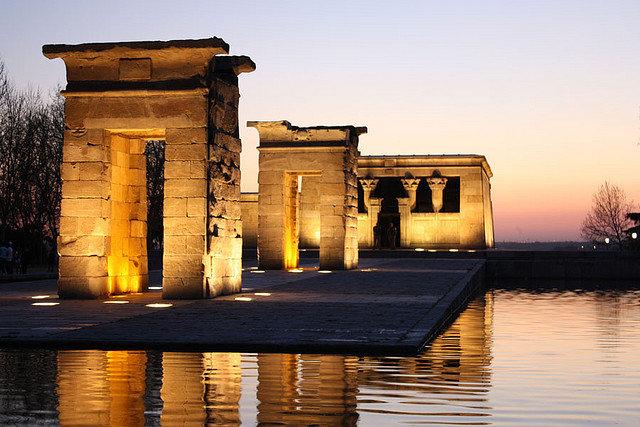
Temple of Debod is an ancient Egyptian temple, reconstructed in Madrid. The temple was originally built in the 2nd century BC, located 15 km south of Aswan, Egypt, and dedicated to the goddess Isis. In the 1960s, the construction of the Aswan High Dam put many ancient buildings and archaeological sites at risk, leading UNESCO to call for international aid in protecting these threatened historic sites. As a gesture of gratitude for Spain's assistance in protecting the Abu Simbel temples, the Egyptian government gifted the Temple of Debod to Spain, where it was reconstructed and completed in Madrid in 1968.
Day2: Madrid
10 attraction(s) ·
6 km
1
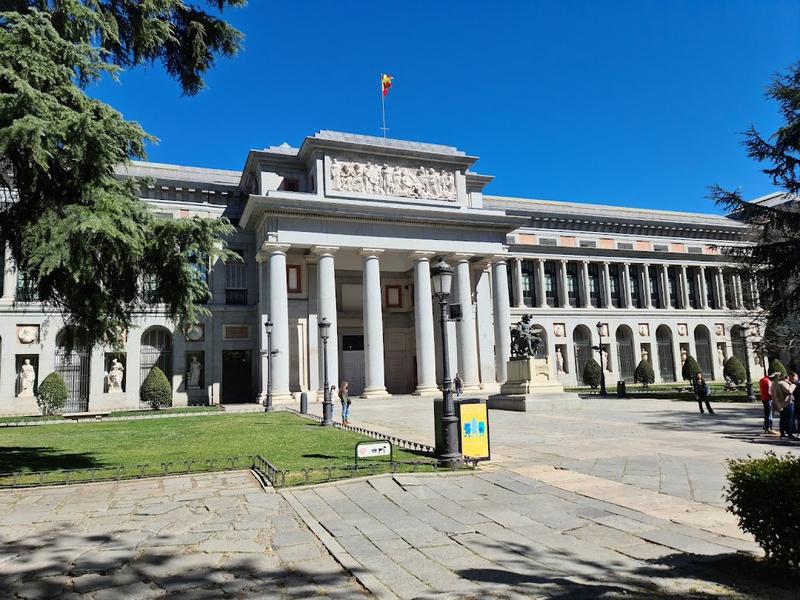
Art museum with Velazquez, Goya and El Greco masterpieces in vast 12th- to 19th-century collection.
1
km
2
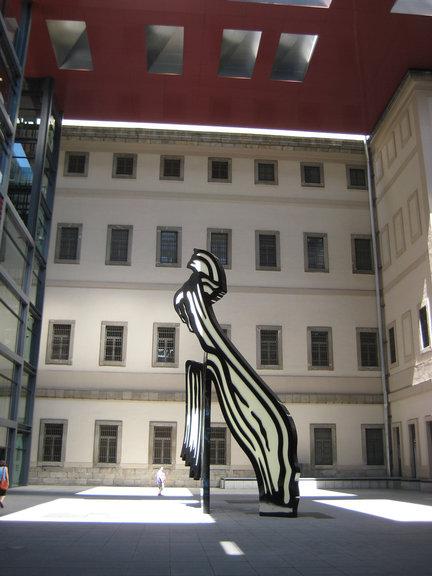
The Queen Sofia Arts Center has nearly 18,000 works of art, spanning from the 19th century to the present day. Among its important collections are works by 20th-century Spanish painters such as Picasso, Dali, and Miro. Notably, there is Picasso's "Guernica," a large painting measuring about 8 meters long and 4 meters wide that depicts the scene of the small Spanish Basque town of Guernica being destroyed by German and Italian air raids during the Spanish Civil War. Visitors are advised to allocate at least two hours to explore these precious artworks.
2
km
3
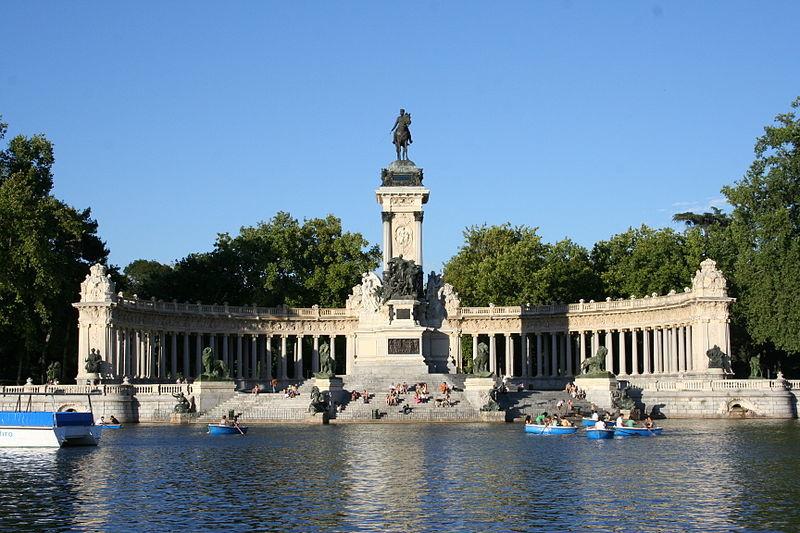
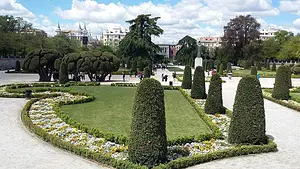
Retiro Park, located in the heart of Madrid, is a vast park covering 118 hectares of land with nearly 15,000 trees and two artificial lakes. It is considered the "lungs" of the city. The park was built in 1630 as a retreat for the king outside of the city. It gradually developed into an area that includes the Teatro Real, the Royal Ballet School, and the Palacio de Cristal. After several renovations and changes in rulers, King Carlos III opened part of the park to the public for recreational purposes. The park includes many attractions such as the Paseo de las Estatuas (Statue Walk), the Puerta de España (Spain Gate), the Rose Garden, the Monument to King Alfonso XII, and the Palacio de Cristal. The Statue Walk features statues of former kings, while the Spain Gate, built during the same period, is part of Gran Via. The Rose Garden is a unique garden that features a variety of rose species imported from various parts of Europe, although most were destroyed during the Spanish Civil War, leaving only 4,000 bushes. The Monument to King Alfonso XII, erected in 1922, is located next to the largest artificial lake in the park and is the largest memorial in the park. The Palacio de Cristal, built in 1887, is one of the most beautiful sights in the park, along with the lake in front of it. It is now primarily used for modern art exhibitions. The lakes are home to various species of birds and reptiles. Retiro Park not only attracts many tourists, but it is also a popular spot for local residents to relax and unwind.
1
km
4

Triumphal arch near to Parque del Buen Retiro & rich with stone carvings & elegant sculptures.
1
km
5
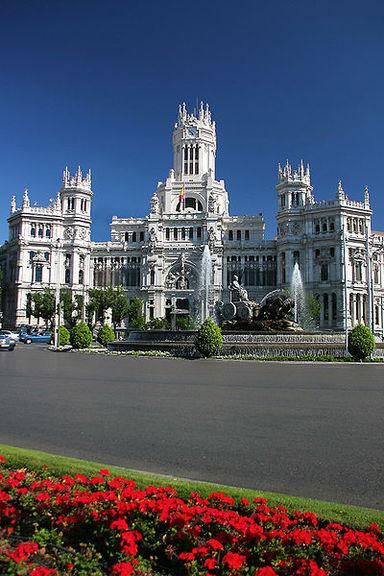
The Plaza de Cibeles, also known as the Goddess of the Earth Square, in Madrid is a place of appreciation for classical aesthetics, architecture, and art. The fountain of Cibeles, built during the reign of Carlos III and designed by Ventura Rodríguez, is the centerpiece of the square. The goddess and chariot are works by Francisco Gutiérrez, while the lion statues are masterpieces by Robert Michel. In the late 19th century, the square and fountain were moved to their current location, becoming a landmark of Madrid. At Plaza de Cibeles, Real Madrid football team has become a symbol of joy as they come here to celebrate their victories.
1
km
6
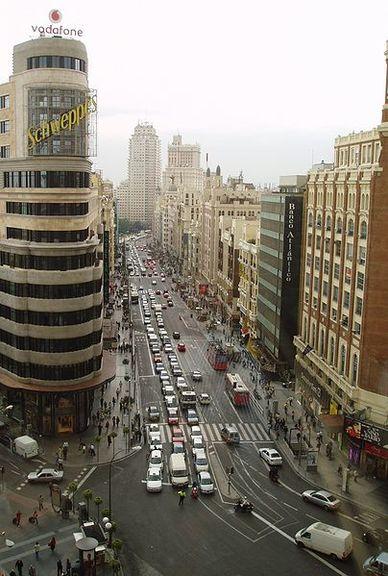
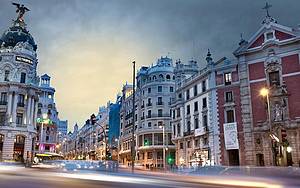
Gran Via is a bustling high-end shopping street in the center of Madrid, with its starting point at Alcala Street and ending at the Plaza de Espana. It is one of the city's most important shopping areas, with many hotels, cinemas, and grand buildings. Although most of the theaters have been replaced by shopping malls, it remains a must-visit tourist destination. In the mid-19th century, Madrid's city planners decided to build a new avenue leading to the Plaza de Espana and carried out large-scale demolitions. However, because construction plans did not begin for decades, the road was considered the "Great Way" (Gran Via). Finally, in 1904, the plan was approved, and construction began two years later. The last section was completed in 1929. Today, Gran Via has become synonymous with fashion shopping, architecture, and culture.
1
km
7

This ornate 1911 beaux arts structure features a gilded cupola with a winged goddess statue.
1
km
8

Grande dame cinema open since 1933 with 3 screening rooms including a 1,360-seat hall & snack area.
1
km
9
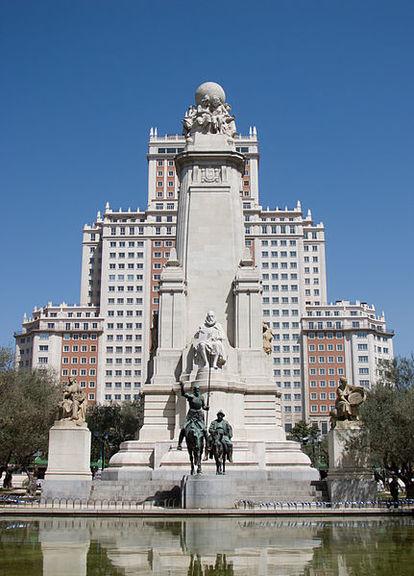
The Plaza de España is located at the end of Gran Via, featuring in the center the Monument to Cervantes accompanied by two tall buildings. The monument was built in 1916 to commemorate the 300th anniversary of the death of Miguel de Cervantes, the greatest writer in Spanish history and the image is that of the protagonist Don Quixote and Sancho Panza from the novel. The tall building on the north side of the square is the Madrid Tower, which has a pure white facade and was completed in 1957 with a height of 142 meters. For the following decade, it was the tallest building in Europe until it was surpassed by the South Tower in Brussels, Belgium at 150 meters in 1967. The tall building behind the Monument to Cervantes is the Spain Building, designed in a specific shape to match the monument's shape and built to avoid blocking the monument's view.
1
km
10
Temple of Debod is an ancient Egyptian temple, reconstructed in Madrid. The temple was originally built in the 2nd century BC, located 15 km south of Aswan, Egypt, and dedicated to the goddess Isis. In the 1960s, the construction of the Aswan High Dam put many ancient buildings and archaeological sites at risk, leading UNESCO to call for international aid in protecting these threatened historic sites. As a gesture of gratitude for Spain's assistance in protecting the Abu Simbel temples, the Egyptian government gifted the Temple of Debod to Spain, where it was reconstructed and completed in Madrid in 1968.
Day3: Madrid
7 attraction(s) ·
5 km


5

Happening, 3-level market with 20 stalls selling diverse, international fare, plus 3 cocktail bars.
1
km

7

Arts & cultural center with movie theater, live performances, exhibition halls & a cafe/restaurant.